Monday, June 29, 2015

TRADITIONAL ARTIST- Maynard Dixon

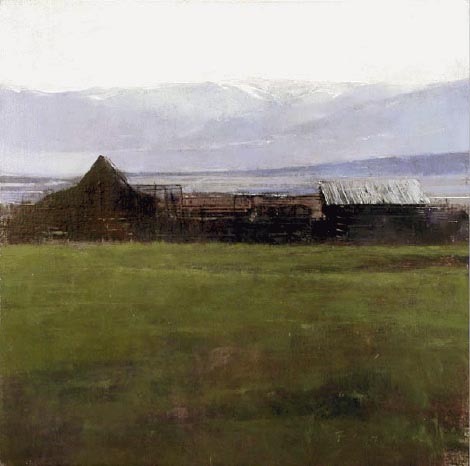
Maynard Dixon (1875-1946) – Landscapes of the West


Dixon was very much a shape/mass painter.  Using large color shapes he created landscape paintings that can sometimes appear abstract.  Dixon didn’t appear to be interested as much in creating a three-dimensional illusion on the canvas – rather, he was more impressionistic in his approach.  The dark (and usually cool) shadow shapes of his painting anchor and support the warm lights and create great value compositions.  I appreciate the obvious success that Dixon achieved in his tenacious grasp on the overall idea/design without getting bogged down in the details, which can destroy a landscape piece.  Simple value design is best – global contrast is good, but local contrast can easily undermine the global effect if taken too far. 


Sunday, June 28, 2015

TRADITIONAL ARTIST- Michael Workman (The 30, 3, 3 Rule)

Michael Workman

I think Michael Workman's paintings are good example of the principle Justin Taylor taught me: "Every good realist painting is also a good abstract painting."


“What you leave out is more important than what you leave in.”

"Great artists have the ability to leave out the superfluous.”
The 30, 3, 3 Rule: 
  • A painting should grab your attention at 30 feet away. 
  • At 3 feet away, the painting should tell a story and create a dialog with the viewer. 
  • 3 inches away, the painting should be interesting to other artists with interesting texture and paint application.


ART IN THEORY- Shadows in Paint

The artist must treat shadows differently than the lights. The greatest degree of value changes in nearly any environment will occur in the lights -- the shadows will be compressed into a much smaller range of the value scale you've established in your painting. Jacob Collins' tells his students, while painting, to keep in mind the phrase "Active lights, passive shadows," and to dwell on it almost like a mantra.

Rembrant - Man in Oriental Costume.
Rembrandt displays in his paintings masterful execution of active lights and passive shadows. Notice how when you moderately squint your eyes the shadowed area of the painting, including the man's hand, optically group into a massive single value -- this is because Rembrandt was acutely aware of how to compress shadows into a small value range in order enhance the illusion of light and form. The viewer would need to squint their eyes more extremely in attempt to view all of the lights as a single massive value -- this is because Rembrandt used a much larger range of values in the light areas.

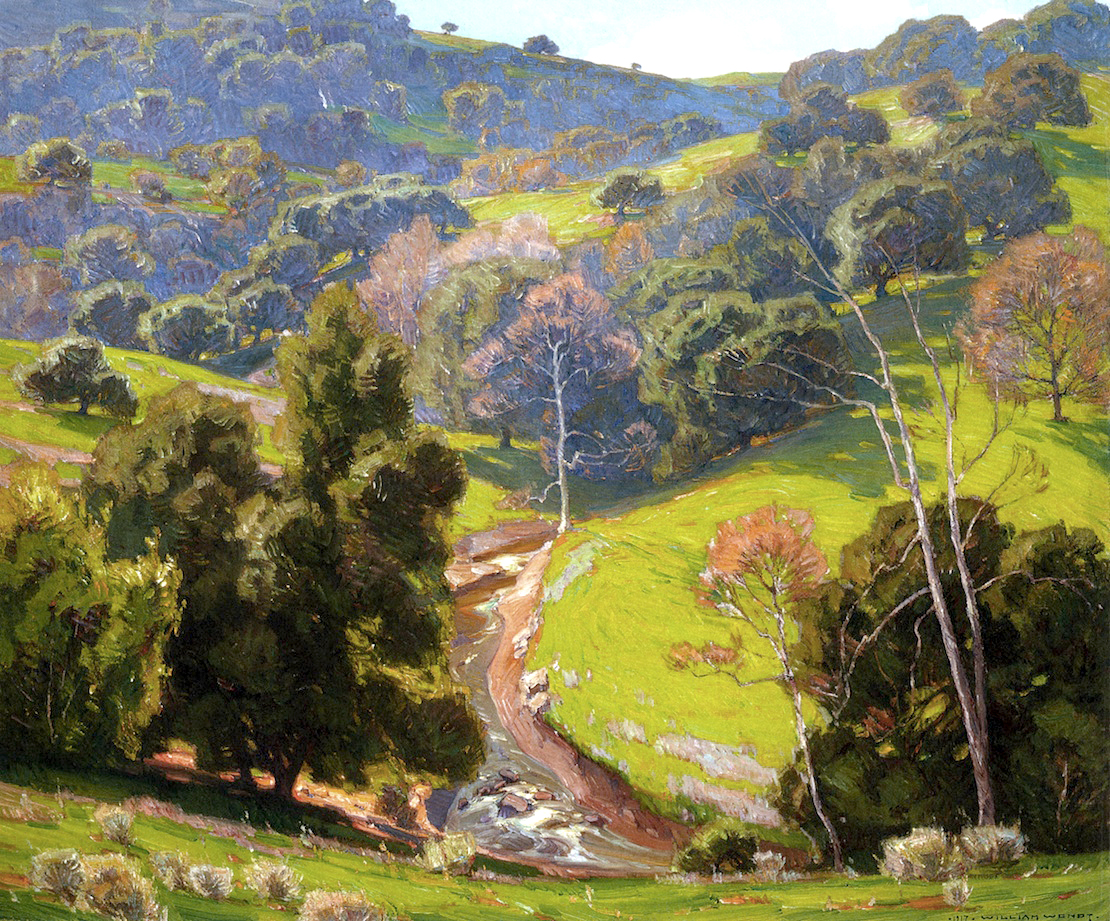
MASTER COPY #1 - William Wendt


Total time was 45 minutes. I didn't use a color picker.
I really liked to see the blues in the tree. I felt like that was a conscious choice to really set them alight.

CONCEPT ARTIST- Aidan Sugano


TRADITIONAL ARTIST- William Wendt

William Wendt (1865-1946)


Friday, June 26, 2015

Edgar Payne & Ernesto Nemesio (lighting a landscape)

Edgar Payne (1883 – 1947)
Edgar Payne; Composition of Outdoor Painting
pg. 154 Edgar Payne would do and experiment where he pick two complimentary colors and then use white to change the value. He would paint an entire scene with only these three colors.
He would also do it with 'split compliments' (red-orange and yellow-orange and blue) This way even very intense contrasted warm and cool colors can be harmonized by gradation.

pg. 154 "The underlying principle of his approach to color, and to art in general, is the balance of vitality(contrast and opposition) with harmony.
Vitality comes from the use of brilliant colors, opposition of light and dark values, complimentary hues, and warm and cool colors.
Harmony is achieved by the use of a pervading color, by modifying complimentary with their opposites, by gradation of value and hue."

pg. 92 "The Soup Method" Premix a large amount of a dominant color, and then inject it into every color that you paint."


Ernesto Nemesio
worked on; Cars 2, Monsters University, The Incredibles, Cars, Ratatouille, Up, Toy Story 3, and Brave, The Dam Keeper (PIXAR)